|
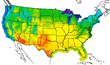
U.S. Day 1 Fire Weather Outlook
   ZCZC SPCFWDDY1 ALL
   FNUS21 KWNS 041640

   Day 1 Fire Weather Outlook
   NWS Storm Prediction Center Norman OK
   1140 AM CDT Mon May 04 2026

   Valid 041700Z - 051200Z

   ...Morning Update...
   No changes were made to the Elevated risk area. Current satellite
   imagery portrays high cloud cover overspreading much of the southern
   Plains and portions of the northern Plains into the Upper Midwest.
   Increasing cloud cover throughout the day is expected to deter
   deeper mixing, maintaining marginal RH across the uppermost High
   Plains. However, RH is still anticipated to remain elevated to near
   critical this afternoon across portions of the TX Panhandle into
   western OK where current surface observations depict 15-30 percent
   values steadily decreasing.

   Presently, a cold front is progressing across northern NE with
   trailing northerly sustained winds of 20-25 mph and gusts up to 35
   mph. Model soundings depict a dry sub-cloud layer and elevated
   instability ahead of the approaching cold front, enhancing the
   possibility for scattered showers and isolated thunderstorms across
   southern NE, western KS and eastern CO. Recent rainfall, a slight
   transition to green up, and expected precipitation overnight may
   alleviate broader fire concerns should any ignitions occur. However,
   areas where fuels remain dry, a west-northerly wind shift with
   sustained 15-20 mph winds through the overnight hours could
   temporarily exacerbate fire weather conditions before appreciable
   rainfall arrives.

   See the previous discussion for more information.

   ..Elizalde-Garcia.. 05/04/2026

   .PREV DISCUSSION... /ISSUED 0136 AM CDT Mon May 04 2026/

   ...Synopsis...
   A cut off low over the Southwest is expected to move eastward as it
   merges with a strengthening subtropical jet stream south of a second
   upper trough over the northern US and southern Canada. Enhanced
   westerly flow aloft will move out of the southern Rockies and over
   the Plains deepening a lee cyclone. This will promote dry and breezy
   conditions over parts of the southern Plains with elevated
   fire-weather conditions likely.

   ...Southern Plains...
   Beneath the southern stream upper low, a lee cyclone will deepen
   over the southern High Plains this afternoon. Trailing the low, a
   developing dryline will serve as the eastern terminus of dry
   westerly flow across parts of eastern NM and the TX/OK Panhandles.
   Warm temperatures with westerly winds of 15-25 mph and 15-20 percent
   RH will overlap a confined region of dry fuels across TX/OK. This
   should support several hours of elevated to locally critical
   fire-weather conditions. Some uncertainty remains on the exact
   dryline positioning later this afternoon. Isolated convection is
   also possible suggesting some precipitation may occur on the eastern
   edge of the Elevated probabilities.

   ...Northern Plains/Midwest...
   Gusty post-frontal winds are likely today across the northern Plains
   and upper Midwest. However, cooler surface temperatures and cloud
   cover will likely keep RH minimums above 35%. Still, some pockets of
   drier air could support brief localized fire-weather concerns in
   pockets of supportive fuels given stronger northwest wind gusts of
   20-30 mph.

   ...Mid Atlantic...
   Gusty southerly winds and a drier than normal air mass are likely to
   develop this afternoon over parts of the Mid Atlantic and Piedmont.
   A strengthening pressure gradient ahead of the deepening upper low
   over southern Canada could support gusts of 10-15 mph. While RH will
   be below 40%, area fuels remains rather limited owing to recent
   precipitation. This should preclude broader fire-weather concerns,
   though some localized risk remains possible.
|
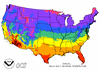
U.S. Day 2 Fire Weather Outlook
   ZCZC SPCFWDDY2 ALL
   FNUS22 KWNS 041856

   Day 2 Fire Weather Outlook
   NWS Storm Prediction Center Norman OK
   0156 PM CDT Mon May 04 2026

   Valid 051200Z - 061200Z

   ...NO CRITICAL AREAS...

   The forecast remains on track, see the previous discussion for more
   information.

   ..Elizalde-Garcia.. 05/04/2026

   .PREV DISCUSSION... /ISSUED 0137 AM CDT Mon May 04 2026/

   ...Synopsis...
   Flow aloft will increase over much of the southern US Tuesday as the
   southern stream upper low merges with the second trough over the
   northern and central US. As the upper-level troughs deepen, a
   surface low over OK will move southward ahead of a surging cold
   front over the Plains, while gusty winds are expected over parts of
   the eastern US.

   ...West TX...
   The cold front is expected to stall across the TX Panhandle Tuesday,
   pushing dry and breezy conditions farther south into Central/West
   Texas. South of the front, westerly winds of 10-20 mph are expected
   along with RH below 25%. This could support some localized
   fire-weather concerns. However, recent plentiful rainfall has
   tempered marginal fuels such that widespread fire-weather conditions
   appear unlikely. Additional precipitation and cooler temperatures
   north of the front should limit fire-weather potential over the
   central US.

   ...Mid Atlantic...
   As the upper trough over the central US consolidates, another day of
   gusty southerly winds is likely over parts of the Mid Atlantic. Warm
   daytime temperatures and minimal moisture ahead of a cold front
   could support localized fire-weather conditions over parts of the
   Carolinas and VA. However, fuels remain limited and any fire-weather
   conditions should be short lived, precluding highlights.
U.S. Day 3-8 Fire Weather Outlook
   ZCZC SPCFWDD38 ALL
   FNUS28 KWNS 042130

   Day 3-8 Fire Weather Outlook
   NWS Storm Prediction Center Norman OK
   0430 PM CDT Mon May 04 2026

   Valid 061200Z - 121200Z

   ...Synopsis...
   An expansive positively-tilted upper trough will extend across the
   Southwest to the Great Lakes region with an embedded shortwave over
   the Rockies on Day 3/Wednesday. Concurrently, a broad upper-level
   low over eastern Canada will encourage unsettled weather across the
   Northeast with a cold front transporting plentiful moisture to
   portions of the Mid-Atlantic and Southeast through Day 5/Friday.
   Broader fire weather concerns may temporarily be dampened for much
   of the eastern U.S. for the duration of the forecast period, given a
   widespread transition to green up and expected appreciable
   precipitation. An upper ridge will build across the Pacific
   Northwest mid-week, resulting in above normal temperatures and dry
   conditions to prevail for much of the western U.S. through the
   weekend.

   On Day 3/Wednesday, the upper trough will migrate atop the southern
   Plains and West TX as an area of surface convergence develops east
   of the Front Range. This feature is expected to send a cold front
   through the TX Panhandle, while downslope westerly winds and a dry
   airmass persists over West TX. Recent plentiful rainfall and
   marginal fuels precludes the introduction of probabilities.

   Beneath an upper ridge and northwesterly flow aloft, above normal
   temperatures and a dry airmass will remain over much of the western
   CONUS with sporadic areas of breezy conditions. Localized fire
   weather concerns may emerge where terrain-induced winds and dry
   fuels align. Farther east, persistent upper-level troughing over the
   northern Plains and Upper Midwest will shunt most moisture chances
   south of the area. Mostly dry and occasionally breezy conditions
   will prevail, promoting localized fire weather concerns where fuels
   remain dry and the green up transition has not yet occurred.

   ..Elizalde-Garcia.. 05/04/2026
|
|